

SMAVI: Standalone Sensor Solution for Demanding Optical Inspection Tasks
Compact Inspection Technology for Demanding Applications
SMAVI combines image sensor technology, illumination, part handling, and image processing in a single integrated unit, enabling complete and high-performance visual inspection without additional peripheral equipment. Thanks to the modular design of the inspection software, both simple and complex inspection tasks can be implemented efficiently and adapted with flexibility.
The high-resolution sensor technology used is specifically designed for demanding surface inspections and measurement tasks. The illumination is configured on a project-specific basis to highlight relevant features and minimize interfering influences.
In combination with application-specific optics and illumination, inspection and defect features are made reliably visible. This enables
- stable, reproducible visualization of surface structures
- reliable detection of even fine or low-contrast features
- geometrically precise imaging for measurement and dimensional inspection tasks
-
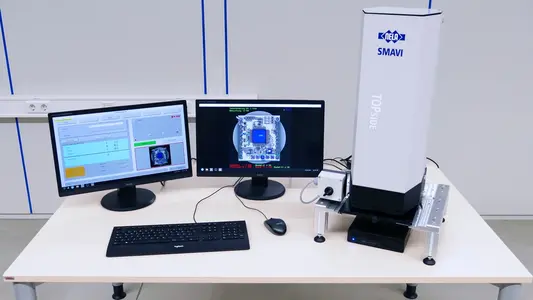
A system that grows with your inspection tasks
Image Processing and Inspection Programs
Image processing with NELA inspection software Visioncheck is an integral part of the system. Inspection programs have a modular structure and can be expanded or adapted in a structured manner. Even complex inspection tasks with multiple inspection features can be combined within a single system. At the same time, operation remains transparent and maintainable – both during commissioning and for later adjustments during ongoing operation.
-
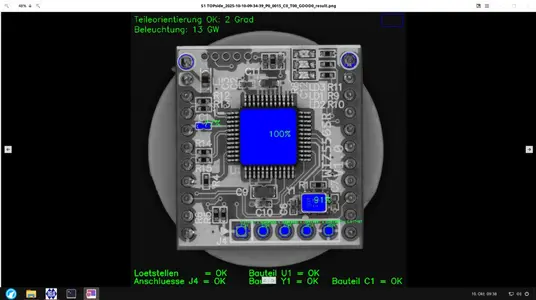
Ideal for changing components and small batch sizes
Flexibility and Quick Changeover
SMAVI is designed for a high level of flexibility in production environments. Direct changeover to geometrically similar products is possible with minimal effort. Conversion to different geometries can also be implemented, inspection programs can be adapted or newly created. This makes the system particularly suitable for changing product variants or small batches with high quality requirements.
From a standalone workstation to a fully automated line: SMAVI adapts to your production environment.
Your advantage: You can start with a manual solution and later integrate the system into an automated line. SMAVI grows with your requirements and your production.
Application Scenarios
The system can be used in various scenarios.
- Manual inspection
- Random sample inspection
- Inspection of small batch production
- Fully integrated solution in automated production lines (line integration)
Thanks to its standalone capability, SMAVI can be operated autonomously or seamlessly integrated into existing industrial processes.
Areas of Application
Typical application areas include:
- precision mechanical systems
- mechatronic components
- electronic assemblies
- high-quality components after machining or surface treatment
SMAVI provides a reliable and cost-effective inspection solution, especially for low-volume, quality-critical products.

Developed for small, precise, and quality-critical components.
Component Sizes and Application Examples
In the example shown, the system is designed for manually fed inspection parts with dimensions of approximately 30 mm in diameter. Solutions for smaller or larger components can also be easily realized.
Typical application areas include:
- precision mechanical systems
- mechatronic components
- electronic assemblies
- high-quality components after machining or surface treatment
SMAVI provides a reliable and cost-effective inspection solution, especially for low-volume, quality-critical products.

Standard Solution or Custom Development depending on Your Requirements
System Availability and Customization
In addition to preconfigured systems, customized solutions are also available. If required, NELA develops customer-specific inspection systems within a short time frame and on a project-specific basis.
This means for you: You do not receive a rigid standard solution, but an inspection system tailored to your components, your inspection features, and your production process.

Become independent instead of relying on external support long-term.
Training and User Autonomy
Training is provided through targeted instruction by NELA experts. After completing the training, users are able to independently modify existing inspection programs and develop new inspection programs on their own. This ensures that the know-how remains within the company and reduces dependence on external support for future modifications.
Your advantage: Changes to inspection features, new components, or variants can be implemented internally – quickly, flexibly, and without waiting times.

Create new inspection programs in the shortest time with AI support
SMAVI and VisionCheckAI
With our AI tool VisionCheckAI, SMAVI becomes exceptionally flexible. New inspection tasks can be trained and deployed at any time without support from NELA experts. Even with just a small number of part images (good and defective), highly reliable inspection programs can be created. This makes SMAVI the ideal solution for environments in which frequently changing parts must be inspected reliably in small quantities.
Especially for small batch sizes, prototypes, or frequently changing components, the effort required to create new inspection programs is significantly reduced. As a result, inspection processes can be set up and adapted much faster.
